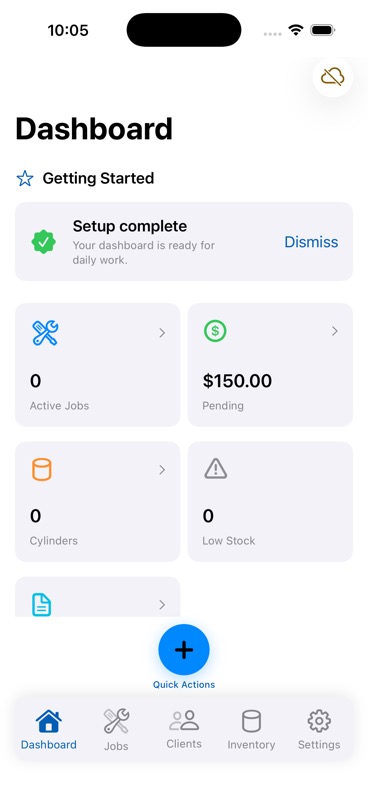
Run Your Entire
HVAC Business
From Your Truck
The all-in-one CRM built for solo techs. Clients, scheduling, estimates, invoices with signatures, inventory, and equipment history on your iPhone — offline-ready. $29.99/mo or $299.99/yr. A fraction of Jobber and Housecall Pro. EPA compliance included.
Free tier forever. No credit card. No contract. Cancel any time. Android coming soon.
Every HVAC CRM is Built for 10-Truck Teams. You Have One Truck.
You're paying monthly for dispatch boards, online booking funnels, team chat, and review campaigns you'll never use — while your clipboard and paper invoices quietly lose you jobs and hours.
Strips out inventory, photo docs, and AI. Forces an upgrade to Connect ($129/mo) or Grow ($249/mo) for a complete tool. No offline mode at all. Zero EPA compliance.
Capped at 1 user and widely criticized as underpowered. A second tech forces a jump to $129+ Essentials. Offline mode is view-only — can't edit a job. No EPA compliance.
Designed for 20+ truck shops. $5K–$50K implementation fee. 2–3 year contracts. If you're solo, you're paying enterprise tax for features you'll never touch.
Quote-gated pricing. $500–$2,000 setup fee. Mandatory 5-week onboarding. No refund on annual if you cancel. Real friction for a one-person shop.
Then You Stack a Compliance Tool on Top
Because none of them handle EPA 608, Subpart C, A2L checklists, leak-rate calculations, or chronic leaker reports — so you pay a second monthly subscription for compliance, plus a third app for refrigerant references. Three apps, three bills, three places your data lives.
FieldPad collapses all three into one iPhone app, for $29.99/mo or $299.99/yr.
Every Tool You Need, In One iPhone App
Stop stitching together a CRM, an invoicing app, a scheduling tool, a compliance tracker, and a refrigerant reference. FieldPad is all of them in one — for $29.99/mo.
Client Management (CRM)
Full client records with address autocomplete. Every job, invoice, estimate, and piece of equipment is linked to the client — giving you the full service history for every customer, one tap away.
Jobs & Work Orders
Create and track service jobs with client, equipment, and status workflow (Pending → In Progress → Complete). Automatic schedule-conflict detection keeps you from double-booking your own day.
Scheduling & Recurring Jobs
Month/week/day calendar with drag-and-drop scheduling. Set up weekly, monthly, or annual recurring maintenance (Pro) so filter changes and service contracts schedule themselves.
Estimates & Quotes
Build detailed estimates with line items, split labor/material tax, and reusable templates for common HVAC jobs. One tap converts an approved estimate into an invoice.
Invoicing with Signatures
Professional PDF invoices with customer and technician signatures collected on the iPhone screen. Split labor/material tax, partial payments, refrigerant line items, and your business logo (Pro).
Cylinder Inventory + OCR Scan
Point your camera at a cylinder label — FieldPad reads serial, refrigerant type, and weight with on-device OCR. Track weights, exchanges, chain-of-custody, and get low-inventory alerts.
Equipment & Asset History
Every piece of customer equipment gets a profile: full charge, appliance type, and a complete log of every job, repair, verification test, and compliance record tied to it.
Smart Notifications
Job reminders, repair deadlines, verification follow-ups, low-inventory alerts, chronic-leaker warnings. Deep-link routing takes you straight to the record that needs attention.
Offline-First Architecture
Every feature works without signal — log jobs, generate PDFs, take signatures, scan cylinders. Data syncs via your private iCloud when you're back online. No servers, no account, no vendor lock-in.
Purpose-Built for the One-Person Shop
FieldPad makes different product choices than team CRMs because your life on a service call is different. Four things your current CRM gets wrong for solo techs:
Glove Mode — 48pt Touch Targets
Every button, text field, and icon is sized so you can tap accurately with insulated gloves on. No peeling off PPE to log a reading or collect a signature.
Offline-First, Not Offline-Later
Every feature works in basements, mechanical rooms, and rural service calls with zero signal. Log jobs, generate PDFs, collect signatures, scan cylinders — it all works, then syncs when you get bars back.
Your Data, Your Device
No login, no account creation, no vendor lock-in. Data lives on your iPhone in SwiftData and syncs via your private iCloud container. We run zero servers — we literally can't see your data, sell it, or hold it hostage.
No Per-Seat Tax, No Setup Fees
$29.99/mo or $299.99/yr. No 2–5 user bundles like Workiz, no $500–$2,000 setup fee like FieldEdge, no 2-3 year enterprise contract like ServiceTitan. No credit card for the permanent free tier.
See How FieldPad Stacks Up
The quick version. Full feature-by-feature matrix here →
| What Solo Techs Actually Need | FieldPad | Jobber | Housecall Pro | ServiceTitan |
|---|---|---|---|---|
| Starting price (solo) | $29.99/mo or $299.99/yr | $29–$39/mo | $59–$79/mo | $200–$400/tech |
| Setup fee / onboarding cost | $0 | $0 | $0 | $5K–$50K |
| Works offline (edit records) | Yes | No | View-only | Partial |
| Inventory tracking | Yes + OCR | Paid add-on | Higher tiers | Yes |
| EPA Section 608 / Subpart C | Included | None | None | None |
| A2L safety checklists | Included | None | None | None |
| Data stays on your device | Yes | Cloud only | Cloud only | Cloud only |
| Min seats / forced team tax | 1 person | 1 | 1 (capped) | ~3+ |
The EPA Compliance Suite Other CRMs Don't Have
Jobber, Housecall Pro, ServiceTitan, Workiz, FieldEdge, and mHelpDesk have zero EPA compliance features. Solo techs usually stack a second subscription ($20–$50/mo) on top. With FieldPad, it's in the box at no extra cost.
Log Service
Record recovery, recharge, leak test, or repair events with refrigerant details
Auto-Calculate
Leak rates via Method 1 or 2 against Section 608 or Subpart C thresholds
Track Repairs
30-day repair deadlines, verification tests, and inspection schedules
Get Alerts
Notifications for deadlines, chronic leaker warnings, and follow-ups
Export Reports
PDF, CSV, or JSON exports for EPA audits and state regulatory reviews
ODS refrigerants (R-22), 50+ lb systems, full leak/repair/verification tracking.
HFC refrigerants (GWP > 53), 15+ lb systems, effective Jan 1, 2026.
6 mandatory checks for R-454B, R-32, R-452B, logged with timestamps.
Method 1 (Annualized) & Method 2 (Screening) with instant pass/fail.
Monitors 125% annual threshold; March 1 reporting deadline tracking.
Instant repair-vs-replace recommendation based on refrigerant cost.
EPA Leak Rate Thresholds Tracked Automatically
| Appliance Type | Section 608 | Subpart C | Charge Minimum |
|---|---|---|---|
| Commercial Refrigeration | 20% | 20% | 608: ≥50 lbs • C: ≥15 lbs |
| Comfort Cooling (AC) | 15% | 10% | 608: ≥50 lbs • C: ≥15 lbs |
| Industrial Process | 30% | 30% | 608: ≥50 lbs • C: ≥15 lbs |
| Refrigerated Transport | N/A | 10% | C: ≥15 lbs (GWP > 53) |
Less Per Year Than One Month of ServiceTitan
Start free, forever. No credit card, no setup fees, no contracts. Upgrade to Pro when you outgrow the limits — at a fraction of what Jobber or Housecall Pro charge.
Competitor prices are published starting rates. Features vary significantly; see the full comparison.
Free
A real, usable tier — not a trial. No credit card required.
- 5 clients, 10 jobs, 10 invoices
- 5 estimates, 20 compliance logs
- 10 cylinders, 15 OCR scans
- 8 PDF generations
- Offline mode, Glove Mode, iCloud sync
- EPA 608, Subpart C, A2L checklists
FieldPad Pro
Unlimited everything. Everything in the free tier, with no caps.
- Unlimited clients, jobs, invoices, estimates
- Unlimited compliance logs & cylinders
- Unlimited OCR scans & PDFs
- Recurring jobs (weekly, monthly, annual)
- Business logo + full digital signatures
- Data + compliance export (JSON, CSV, PDF)
Upgrade to Pro in-app. No contract. Cancel any time.
HVAC Business & Compliance Resources
How to run a profitable one-person HVAC shop — invoicing, pricing, client retention — plus EPA compliance and A2L safety guides.
Quote Conversion Rate for Solo HVAC: Why 3-in-5 Is the Benchmark and How to Hit It
Quote conversion rate — the percentage of estimates that become signed jobs — is the single most leveraged number in a solo HVAC business. A tech converting 60% of estimates...
businessNew Client Onboarding for Solo HVAC: What to Capture on the First Call
The first phone call or first service visit with a new HVAC client is the only time you have a socially-acceptable window to ask a long list of questions. If...
businessScheduling Optimization for One-Truck HVAC Shops: Reducing Windshield Time
For a one-truck HVAC shop, windshield time is unpaid overhead. Every extra mile between job sites is labor you're not billing and fuel you're paying for out of the margin...
businessFrom Estimate to Signed Invoice in 10 Minutes: The Solo HVAC Close-Out Workflow
The gap between finishing a repair and getting paid is where solo HVAC businesses lose revenue. Every day a signed invoice sits unsent is a day the client's memory of...
businessRecurring Maintenance Contracts: The Solo HVAC Tech's Guide to Predictable Monthly Revenue
Recurring maintenance contracts turn unpredictable service-call revenue into stable monthly or seasonal cash flow. For solo HVAC techs, a portfolio of 75-150 PM agreements typically generates enough baseline revenue to...
toolsUnderstanding Refrigerant GWP Values: A Quick Reference for Field Technicians
Global Warming Potential (GWP) is the key factor determining which EPA regulatory framework applies to a refrigerant. Under the AIM Act, Subpart C applies to HFC refrigerants with GWP above...
complianceVerification Test Requirements: Initial and Follow-Up Leak Testing Under Section 608 and Subpart C
After repairing a refrigerant leak on regulated equipment, EPA regulations require technicians to perform verification tests to confirm the repair was successful. An initial verification test must be conducted immediately...
complianceEPA Record-Keeping Requirements: What Solo Techs Must Document and Retain
EPA regulations require HVAC technicians to maintain detailed records of all refrigerant handling activities for a minimum of 3 years. Required documentation includes service dates, refrigerant types and quantities recovered...
safetyEmergency Response Procedures for Refrigerant Leaks: A Solo Tech's Protocol
Refrigerant leaks in enclosed spaces can create oxygen-depleted or flammable atmospheres that pose immediate safety risks. Solo HVAC technicians must have a clear emergency response protocol: evacuate the area if...
businessTime Management for Solo HVAC Technicians: Balancing Service Calls and Paperwork
Solo HVAC technicians juggle two roles: field technician and business owner. Every hour spent on paperwork, compliance documentation, and invoicing is an hour not spent on billable service calls. Effective...
complianceUnderstanding Full Charge Determination Methods for EPA Compliance
Accurate full charge determination is the foundation of EPA leak rate calculations. The full charge is the total amount of refrigerant required for a system to operate at designed capacity....
safetyRefrigerant Cylinder Handling and Storage: Safety Guidelines for Field Techs
Proper refrigerant cylinder handling is critical for both safety and EPA compliance. Cylinders must be transported upright and secured, stored in well-ventilated areas away from heat sources, and never filled...
toolsOffline-First HVAC Apps: Why Connectivity Shouldn't Limit Your CRM (or Your Compliance Tracking)
HVAC technicians frequently work in basements, mechanical rooms, rooftops, and rural locations where cellular connectivity is unreliable or nonexistent. Cloud-dependent apps that require an internet connection for basic functions leave...
complianceA Complete Guide to EPA Chronic Leaker Reporting Requirements
Under EPA regulations, refrigeration or AC equipment is classified as a chronic leaker when cumulative refrigerant additions in a calendar year exceed 125% of the equipment's full charge. Once triggered,...
businessBuilding a Repeat Client Base as a Solo HVAC Service Technician
For solo HVAC technicians, repeat clients are the foundation of a sustainable business. Acquiring a new client costs 5-7 times more than retaining an existing one. Building a repeat client...
safetySafe Recovery Procedures: Best Practices for ODS and HFC Refrigerants
Refrigerant recovery is a core competency for EPA Section 608-certified technicians. Safe recovery requires proper equipment rated for the specific refrigerant type, clean and appropriately labeled recovery cylinders, and careful...
businessCreating Professional HVAC Service Invoices That Get Paid Faster
Professional invoicing directly impacts a solo HVAC technician's cash flow. Invoices that clearly itemize labor hours, material costs, refrigerant usage, and applicable taxes get paid faster and generate fewer disputes....
complianceThe 5,000 Rule Explained: When to Repair vs Replace Refrigeration Equipment
The 5,000 Rule is an EPA guideline that helps HVAC technicians decide whether to repair or replace leaking refrigeration equipment. The calculation multiplies the cost of refrigerant per pound by...
businessManaging Your Refrigerant Cylinder Inventory: A Solo Tech's Strategy
Refrigerant inventory management is both a business necessity and a compliance requirement for solo HVAC technicians. Carrying the right mix of refrigerants (R-410A, R-22, R-454B, R-32) without overstocking ties up...
safetyPPE Requirements for Handling Modern Refrigerants: A Field Guide
Proper personal protective equipment (PPE) is essential for HVAC technicians handling refrigerants. Minimum PPE for all refrigerant work includes safety glasses or goggles, insulated gloves rated for cold contact, and...
toolsPreparing for an EPA Audit: Documentation Every Solo Tech Needs Ready
EPA compliance audits can happen with or without advance notice, and the consequences of inadequate documentation are severe — fines can reach $44,539 per day per violation. Solo HVAC technicians...
complianceLeak Rate Calculations Demystified: Method 1 vs Method 2 for Field Technicians
EPA requires HVAC technicians to calculate leak rates when servicing regulated refrigeration and AC equipment. Method 1 (Annualized) uses the formula: (refrigerant added ÷ full charge) × (365 ÷ days...
businessSetting Competitive Service Rates as an Independent HVAC Technician
Pricing is one of the most critical business decisions for independent HVAC technicians. Your rates must cover operating costs (vehicle, tools, insurance, certification), provide a living wage, and remain competitive...
safetyR-454B and R-32: What Every HVAC Tech Needs to Know About A2L Refrigerants
R-454B (GWP 466) and R-32 (GWP 675) are A2L-classified refrigerants replacing R-410A (GWP 2088) in new HVAC equipment as part of the AIM Act's HFC phasedown. Unlike R-410A, these refrigerants...
complianceSubpart C vs Section 608: Understanding the New HFC Leak Repair Thresholds
Since January 1, 2026, HVAC technicians must comply with two separate EPA regulatory frameworks: Section 608 for ODS refrigerants (like R-22) in systems with 50+ lbs of charge, and Subpart...
toolsGoing Digital: Why Solo HVAC Techs Are Switching from Paper to App-Based Record Keeping
Solo HVAC technicians who switch from paper-based record keeping to digital apps report significant improvements in compliance documentation accuracy, invoicing speed, and audit readiness. Paper records are vulnerable to loss,...
safetyA2L Refrigerant Safety: 6 Mandatory Steps for Your Digital Compliance Log
A2L refrigerants like R-454B, R-32, and R-452B are classified as mildly flammable under ASHRAE 34. Servicing A2L systems requires six mandatory safety steps: (1) confirming dissipation risk assessment, (2) verifying...
businessHandling Client Expectations While On-Site: A Solo HVAC Pro's Guide
Managing client expectations is one of the biggest challenges for solo HVAC technicians. Unlike larger companies with dedicated dispatchers and customer service teams, solo techs must handle client communication alongside...
complianceThe Solo Tech's Complete Guide to EPA Section 608 Compliance in 2026
EPA Section 608 of the Clean Air Act regulates the handling of ozone-depleting substance (ODS) refrigerants in HVAC and refrigeration systems. For solo technicians servicing systems with 50 or more...
Run Your Whole Business From Your Truck
Clients, scheduling, estimates, invoices with signatures, inventory, equipment history — one iPhone app, offline-ready, for $29.99/mo or $299.99/yr. EPA compliance included.
Download FieldPad FreeFree tier forever. No credit card. iPhone & iPad. iOS 17+. Android coming soon.